


Wow Nathan! What a question to start us off! Thank you for asking it.
We may think of a book as a stack of pages bound together, with writing on it. The earliest book, where sheets of paper were bound on one side, was called a codex. Codices (plural for codex) were found as early as the first century in Egypt and the Roman Empire.
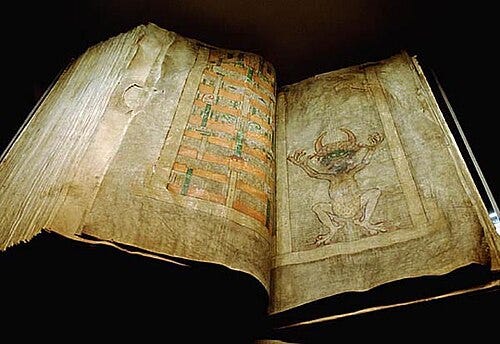
The “Codex Gigas”, a large Latin Bible, from about 1300 CE* Bohemia (now the Czech Republic). (Image attributed to Kungl. Biblioteket, from Wikipedia.org)
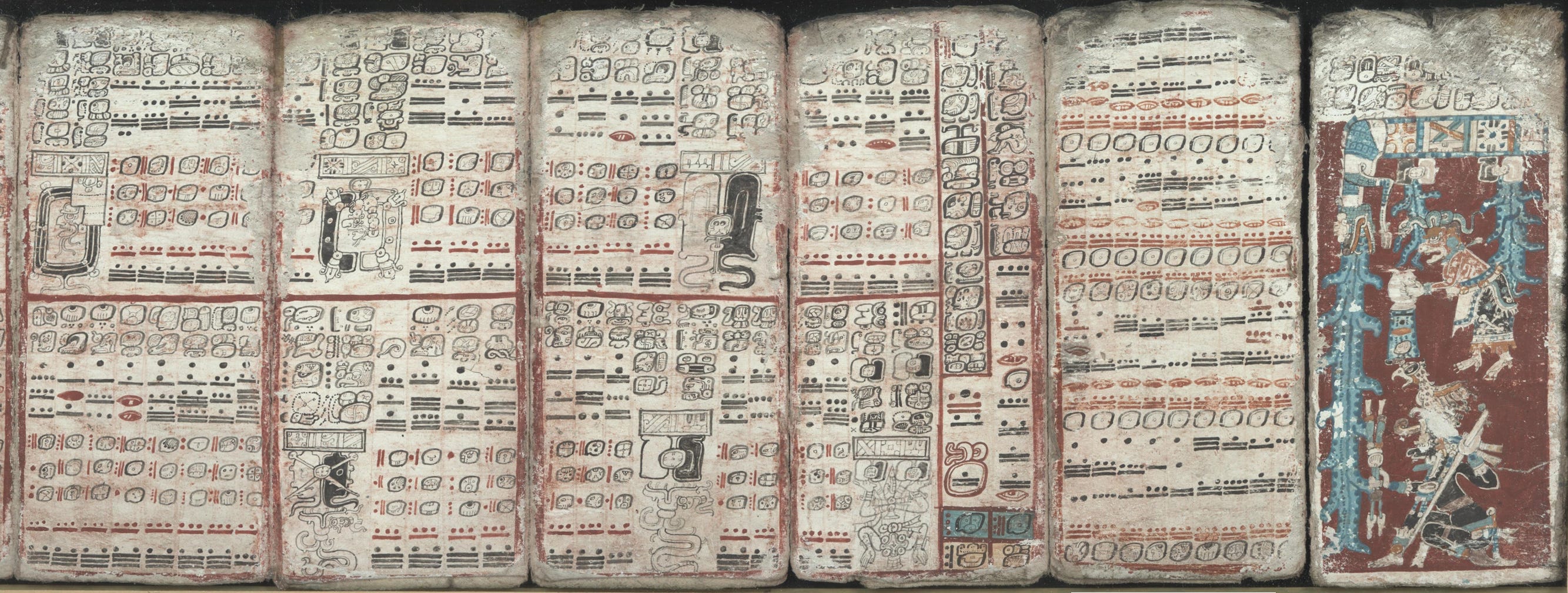
The “Dresden Codex”, from the Mayan civilization (region of Mexico), dating back to about 1200 – 1345 CE. (Public domain image, from Wikipedia.org)
However, books did not just come about at a single moment in history. Before the bound format, written materials appeared in history as manuscripts, scrolls, and several other formats. The form of the book was a huge improvement over the other formats, for ease of reading and carrying around!
Books involved several main human inventions – material, language, and the ink that put the writing on the material. Most importantly, the invention of the printing press allowed books to be made quickly, and for many people. Let’s see how these inventions evolved to deliver the modern-day book that we know!
Materials for writing on
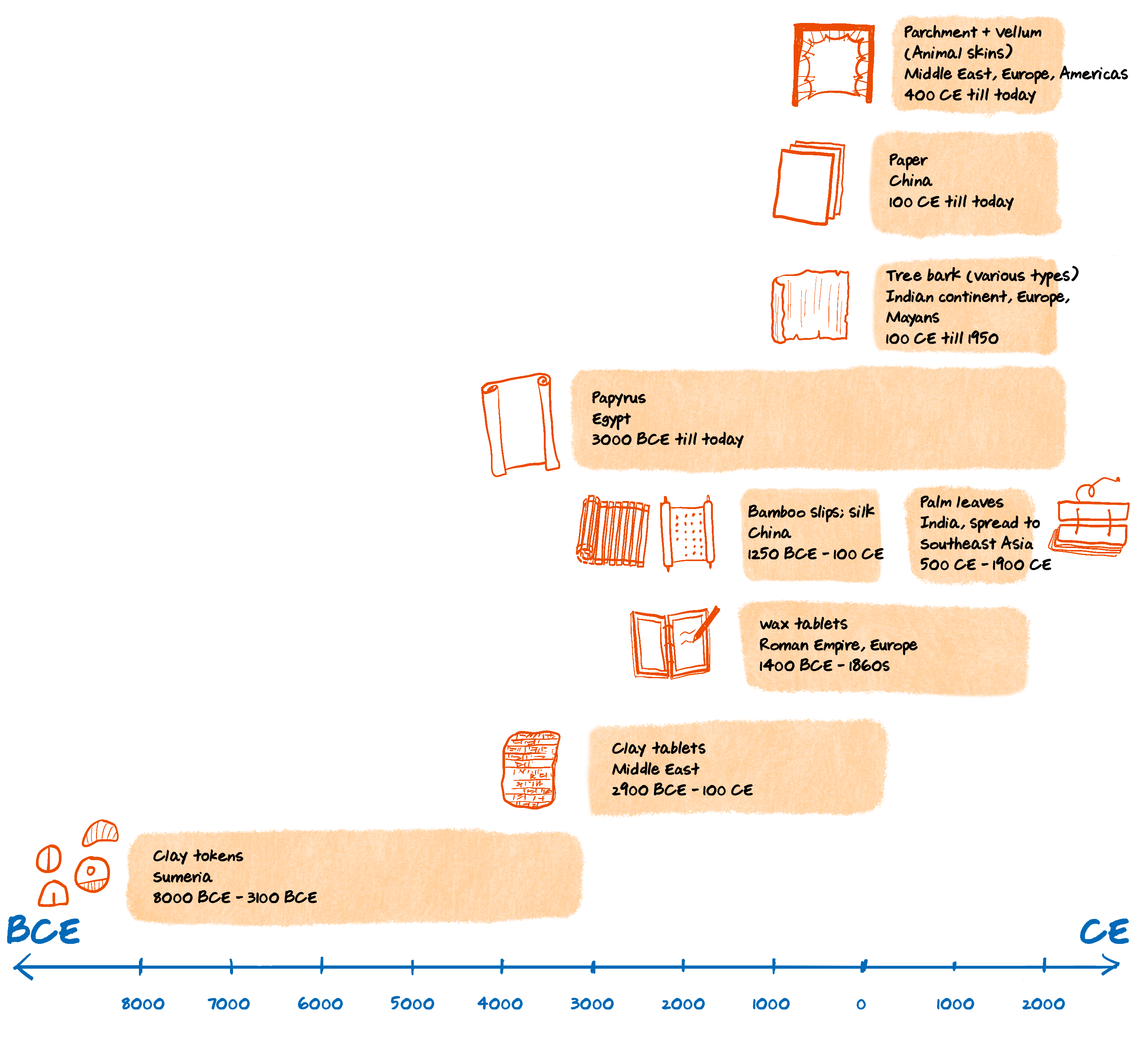
The paper that we know today is attributed to an invention in 100 CE by a Chinese court official named Tsai Lun. He mixed the bark of mulberry trees and bamboo, pounded the mixture, and drained it through a cloth to obtain the fibers. The fibers were dried to make paper – lightweight, cheap, and easy to make.
However, as you can see from this diagram, people all over the world were independently trying to figure out how to improve the materials for writing on!
Just for laughs
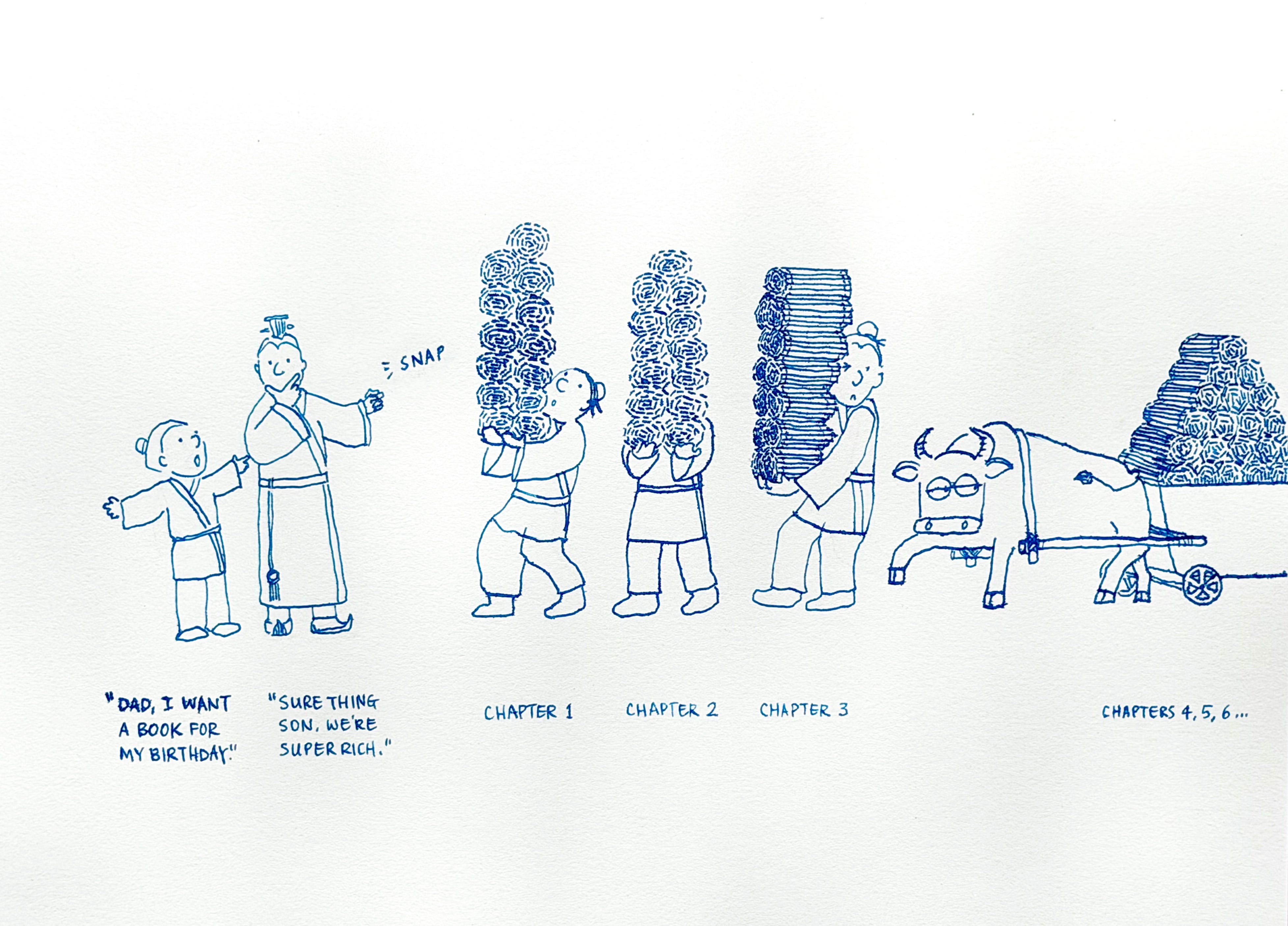
Ordering a book in 200 BCE China before the invention of paper would have meant the delivery of hundreds of bamboo scrolls! What a labor-intensive effort!
Ink and writing instruments
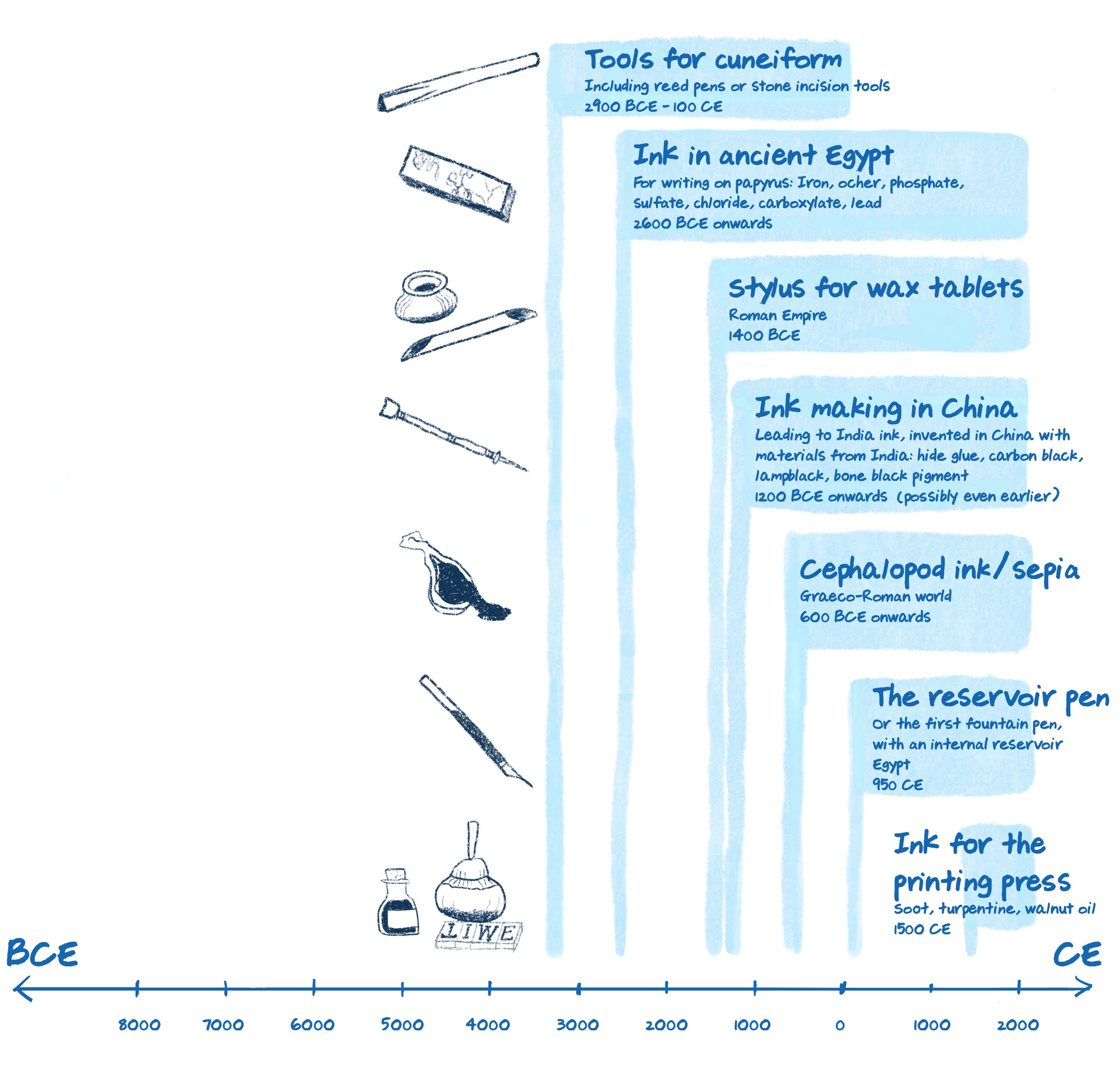
Tally marks of numbers or dates were found on bones as early as 30,000 BCE, in Europe and Africa! The more recent development of ink and writing instruments coincides with the development of materials for writing on. When the printing press was created, it replaced the laborious hand-copying of books. More on that in a minute! Colored inks were introduced in 1770s, and colored printing was introduced in the 1900s.
Language and Writing
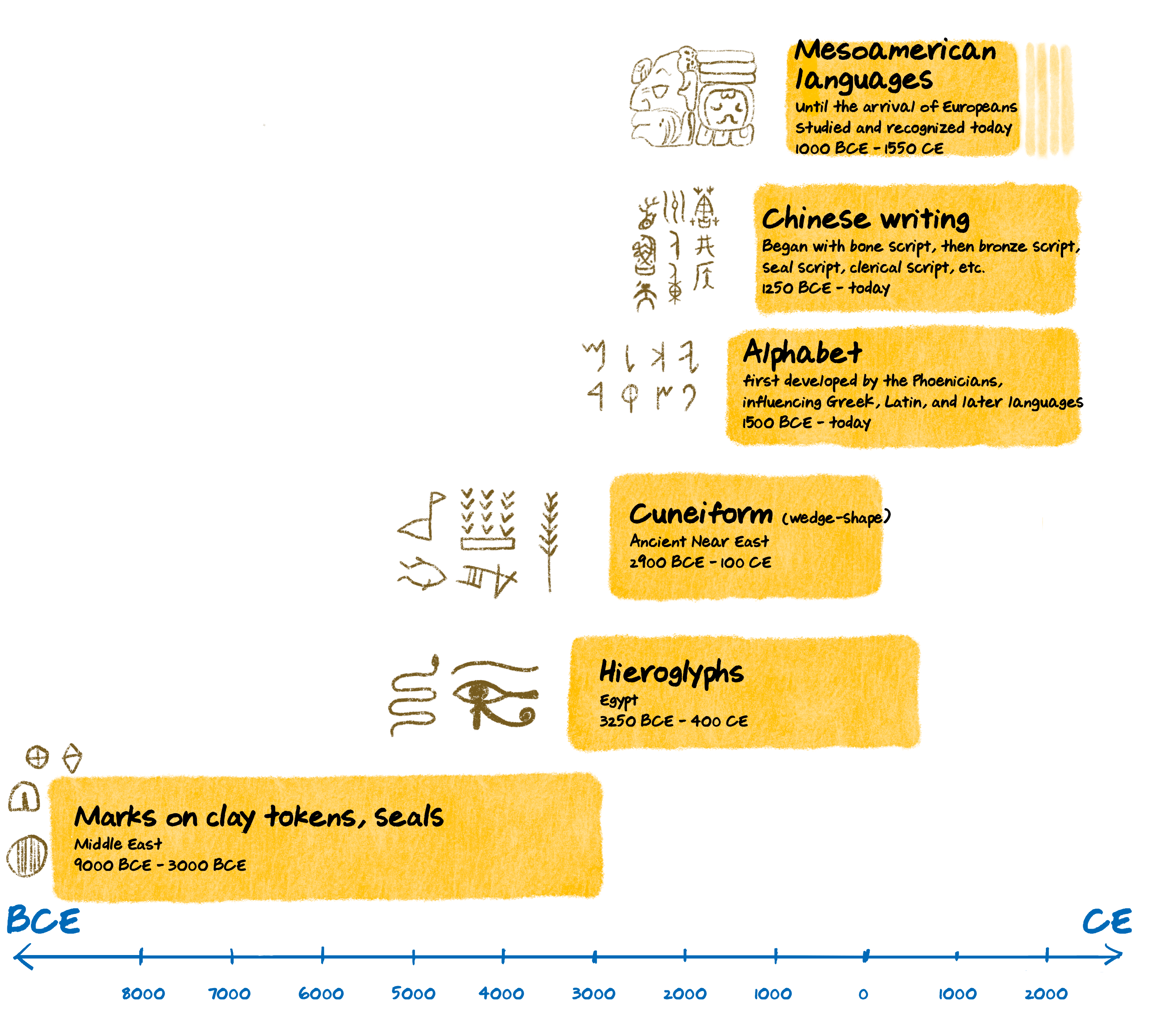
Language is how we convey meaning to one another. The best-known systems of language and writing developed independently in the ancient Near East, China, and South Americas. These led to languages spoken and written by large civilizations and regions of the world.
The Printing Press
Ancient books were handwritten, which cost a lot and took a long time to make! Around 1450, the German Johannes Gutenberg developed the first printing press in Europe. In the design, a flat plate pushed a wooden frame holding paper down onto inked metal type.
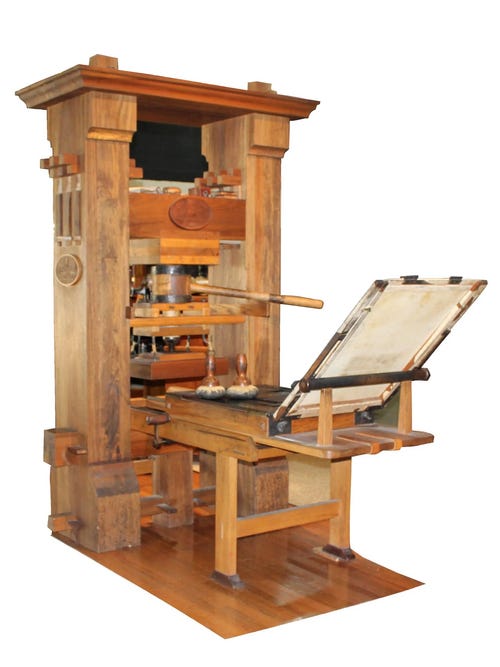
A replica of the Gutenberg Press at the International Printing Museum in Carson, CA. (Public domain image, from Wikipedia.org)
Video: See the Gutenberg Press in action
The printing press produced many books in a much shorter time, and allowed anyone who wasn’t rich to afford a book!
And that’s an abbreviated history of when (and how) books were invented.
*Note:
BCE and CE refer to “Before the Common Era” and “Common Era”. Similar to to BC and AD (“Before Christ” and “Anno Domini”), they refer to the years before and after the birth of Jesus Christ. This system of counting calendar years was established around 525 CE during the Byzantine empire.
Text and drawings by:
Karen E. Hong, an author and illustrator from the San Francisco Bay Area in California. Karen’s picture book “Tea Leaf Eggs” will be released in Feb 2027 -- pre-order here!
Sources:
History: From the Dawn of Civilization to the Present Day, by the Smithsonian Institution
Britannica all new Kids’ Encyclopedia, by Christopher Lloyd with >100 experts
Book recommendations:
For the grown-ups: “Cloud Cuckoo Land” by Anthony Doerr is based on an ancient codex.
To learn more about printing, visit:
Letterpress printing museum around the world
The American Bookbinders Museum in San Francisco, CA
The International Printing Museum, Carson (Los Angeles area), CA